Vornin
Start free

A vulnerability scan service that proves the fix

Less noise in the queue: rule-based detection with AI filtering false positives from code findings. Attack surface, web apps, APIs, networks, code, containers and cloud deduplicate into one record with ownership, SLA escalation and automatic mapping to nine compliance frameworks.

No credit card required · Read-only access · EU-hosted · Repository data deleted after each scan

Scan every exposed surface

Run attack surface, web app, API, network, code, container, Kubernetes and cloud checks in one place. If a check cannot run, Vornin shows the coverage gap instead of reporting a false clean result.

One findings record across all scans

Repeat detections are fingerprinted and combined into one finding and lifecycle. Scheduled profiles run daily, weekly, or monthly in your organisation's timezone using a consistent configuration.

Daily external attack surface monitoring tracks new hosts, certificates, DNS records, and exposed services. High-value discoveries can queue a full scan, while emerging-threat checks show whether an actively exploited vulnerability affects your stack.

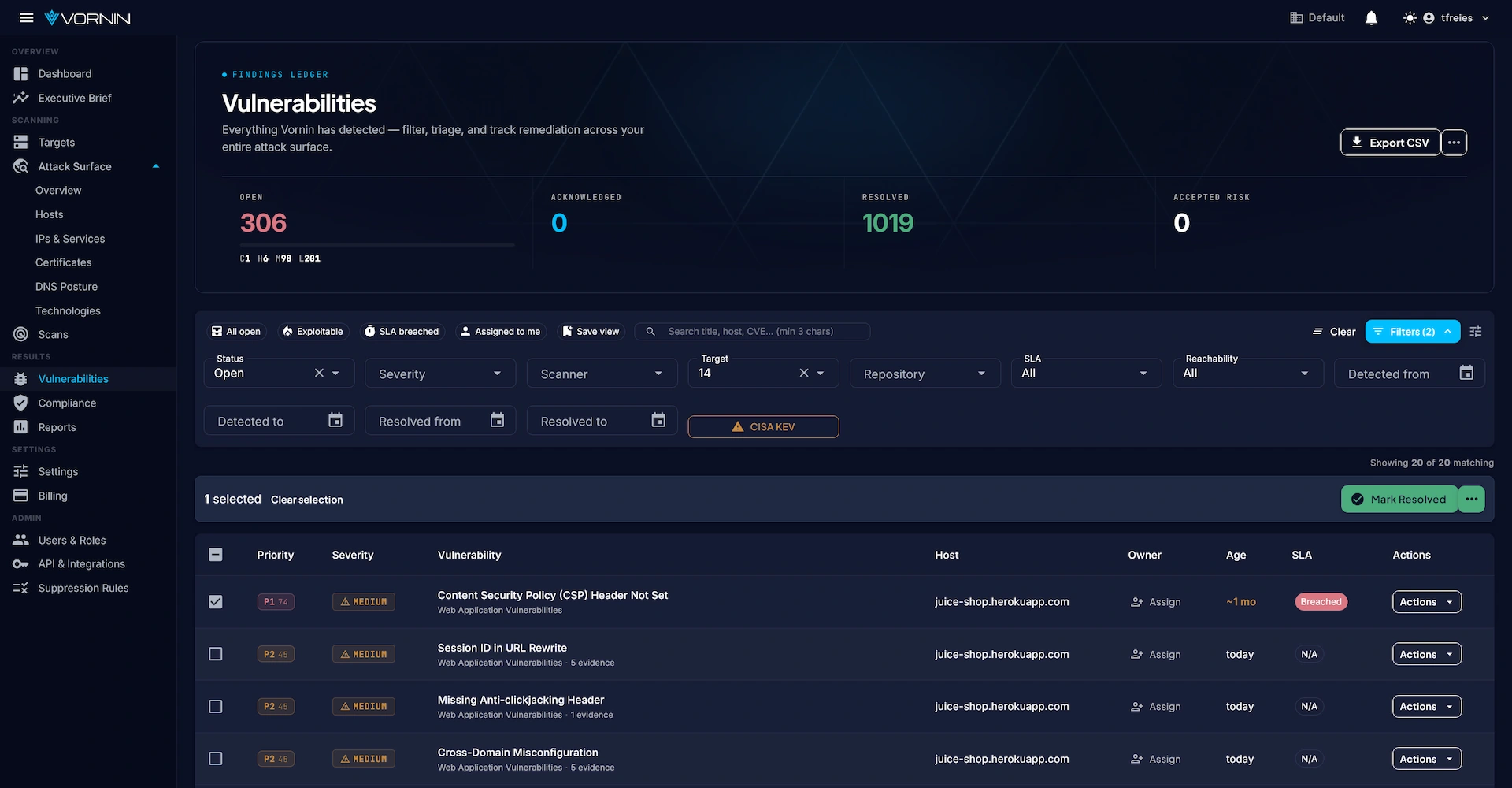
Vornin vulnerability overview listing findings with severity, status, ownership, SLA, and filtering controls.
Vulnerability overview with filtering, ownership, SLA state, and resolution status
  • Web and API

    Web vulnerability scanner, authenticated scanning, API security, known vulnerability checks, WordPress scanner. OWASP Top 10 (DAST) coverage, REST and GraphQL checks, configurable crawling and authenticated scanning.

    • 0 false positives across 2,740 OWASP Benchmark cases*
    • Credential validation before launch, per-engine receipts
  • Attack surface and infrastructure

    Subdomain discovery, takeover detection, port scanning, SSL/TLS analysis, DNS security. 45+ passive discovery sources, service and version detection, certificate and cipher checks, plus SPF, DKIM, DMARC, DNSSEC and CAA.

    • 20% more UDP services identified than nmap*
    • Matched Qualys SSL Labs on every TLS check, using our own engine*
  • Code and supply chain

    SAST, secret scanning, dependency scanning, licence review, runtime end-of-life detection. 1,000+ SAST rules across 12 languages. Dependency scanning ranks the packages your code imports. Secrets are masked, with opt-in live verification. Licence review flags packages whose licences need legal review. Runtime checks catch Node.js, Python and .NET versions that no longer get security fixes. AI reviews every code finding for false positives. CycloneDX SBOM output.

    • 95% of OWASP Benchmark vulnerabilities detected, 65% fewer misses than Semgrep CE*
    • 100% of known dependency advisories found, zero false alarms*
    • 100% secret detection rate, ahead of gitleaks and TruffleHog*
  • Cloud and runtime

    Container image scanning, Kubernetes posture, cloud security posture, infrastructure-as-code scanning. Image and cluster checks plus 600+ read-only posture checks per provider across AWS, Azure and Google Cloud.

    • Found 49% more IaC misconfigurations than Trivy, 15% more than Checkov*
    • Up to 95% less container noise*

Support for other scanner results: Import Nessus, OpenVAS, CSV, and JSON results into the same findings, evidence, and compliance workflow. Vornin normalises the imported results but does not run those scanners.

* Vornin internal testing, September 2026. All tools were run on the same data corpus and scored using the same method.

Resolve each finding
on its own record

Vornin de-duplicates repeat detections, so each issue is tracked once across scans. Owner, SLA, discussion, scan evidence, and verification history stay together from detection to closure.

One record
  1. Detection

    Scans record severity, fingerprint, affected host, URL, and supporting evidence for each finding.

  2. Prioritisation

    Findings are ranked by a rule-based score that measures true exploitability: predictive and deterministic threat intelligence (EPSS, CISA KEV), public exploit code and reachability, weighed with severity, SLA urgency, compliance impact and age. Exploited, critical, overdue or confirmed-reachable findings are never deprioritised.

  3. Ownership

    Each finding can be assigned an owner, with comments, deadlines, and escalations kept on a single timeline.

  4. Verification

    Rescans close findings automatically once an issue is fixed. You can also verify a fix manually for an individual finding.

Reachability, not just presence

Rank vulnerable packages by whether your code imports them, across JavaScript, TypeScript, Python, Go, Java and C#, so unused dependencies do not outrank live exploit paths. Development-only and transitive packages are flagged. Reachability weighting can be disabled if raw severity is wanted.
SLA enforcement with auto-escalation

Business workspaces can set remediation deadlines by severity and automatically send escalation emails, webhooks, and owner notifications when SLAs are missed.

Every action on one timeline

Comments, status changes, reassignments, and suppressions stay on one tamper-evident finding timeline, preserving who did what and when for audit.

AI on every finding, rules on every decision

AI writes plain-language context and fix guidance for every finding, reviews every code finding for false positives to reduce noise, and triages exploitability on request.

Skip the noise
Built-in noise filters, AI false-positive review and your own suppression rules cut scanner noise, by up to 95% on container scans. Findings that are exploited, critical or overdue are never hidden. Suppression rules record a reason and creator. Risk acceptance can be self-approved and expiry is optional.
Compare scans
Compare scan runs to see what changed before and after deployment: new, resolved, and unchanged findings.
Align remediation workflows
Connect remediation to the tools your team already uses with deduplicated tickets, PR comments, signed webhooks, and chat notifications.
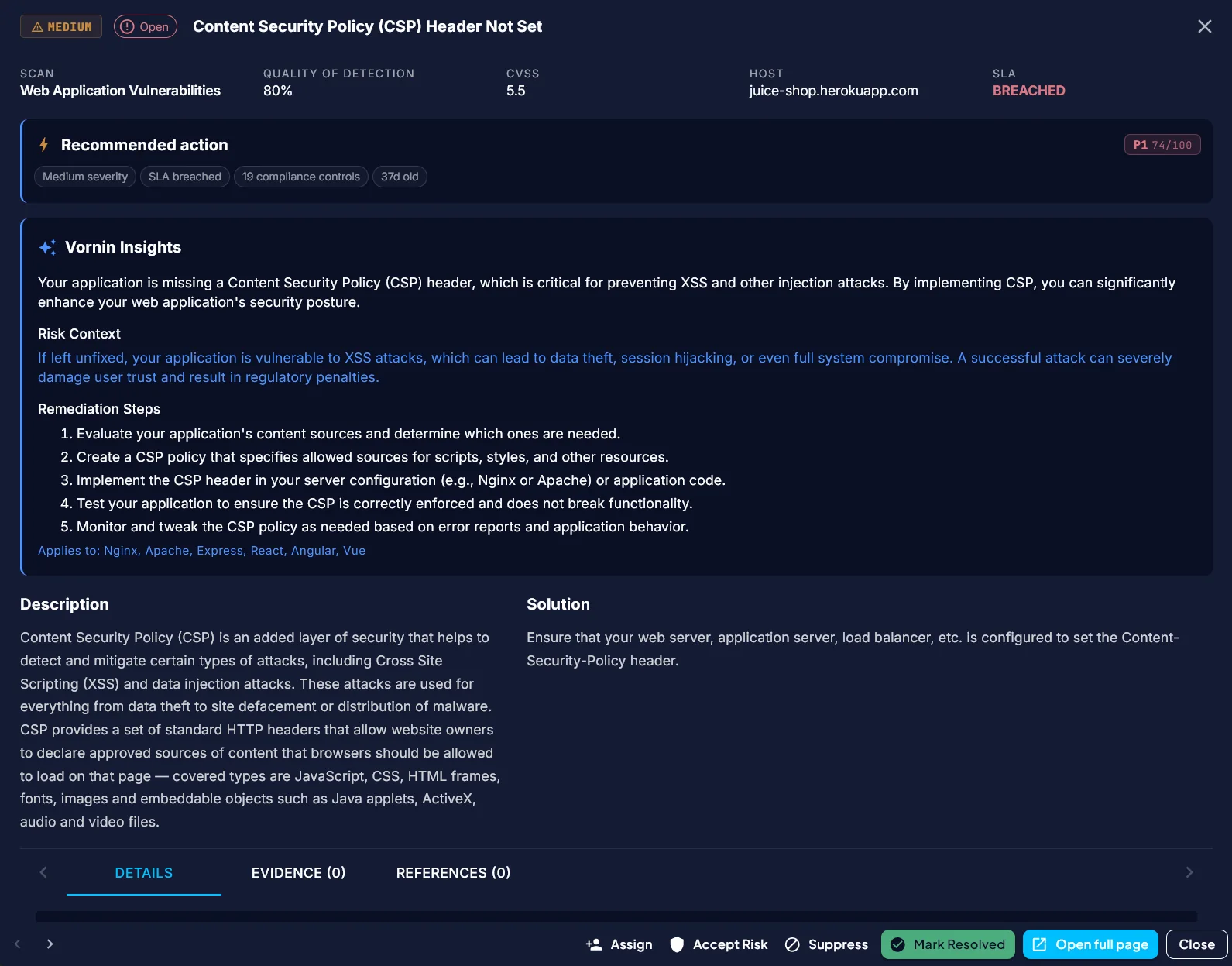
Vornin finding detail showing priority, SLA state, AI-assisted context, remediation steps, assignment, suppression, and resolution controls.
Finding detail with rule-based priority, SLA state, AI context and triage

Prove what happened

Each finding maps to relevant technical security controls. Every lifecycle event becomes part of a tamper-evident evidence chain that technical teams and auditors can verify independently.

  1. Detected a3f1…7e2c
  2. Acknowledged 8c4b…109a
  3. Assigned d720…4ff1
  4. Re-detected 05b7…cc31
  5. Resolved f49e…6203

Each event hashes the previous link and its own payload. Rewriting an earlier event breaks every link that follows.

Auditor pack per finding

Business Scale

Export a complete, self-verifiable evidence pack for any finding. It includes the current finding state, full event and comment history, compliance mappings, supporting evidence, chain verification, and everything needed to independently reproduce that verification, the same evidence you would attach to a customer security questionnaire.

Tenant-wide auditor pack

Business Scale

Export a single PDF covering every finding lifecycle and chain status in one audit record.

Reporting and exports

Team Business Scale

Generate an executive brief and technical report from every scan without manual reformatting. On Team and above, export findings as CSV, Static Analysis Results Interchange Format (SARIF) 2.1.0, or a CycloneDX software bill of materials (SBOM), and schedule PDF delivery. Business adds custom branding; Scale adds full white-label delivery.

Nine pre-mapped frameworks

Findings are automatically mapped to relevant technical security controls. Controls that scanners cannot test are clearly marked for manual attestation, never automatically counted as complete. Every export keeps the evidence connected to its control and source finding.

EU directiveNIS2
Article 21 risk-management measures
EU regulationDORA
ICT risk and incident reporting
ISO/IEC standardISO 27001:2022
A.8.8 and related technological controls
AICPA attestationSOC 2
Security Trust Services Criteria
Payment standardPCI DSS 4.0
Requirements 6 and 11
US regulationHIPAA
Security Rule safeguards
EU regulationGDPR
Articles 32 and 33
US frameworkNIST 800-53 Rev 5
Control families RA, SI, and CM
Best-practice frameworkCIS Controls v8
18 controls across IG1, IG2, and IG3

Operate at organisation scale

Data isolation between organisations
Each organisation's data is isolated at the database layer, preventing one customer from accessing another customer's records.
SSO & MFA
Passwordless magic links by default. TOTP MFA per user, tenant-enforced when required. Per-tenant SAML 2.0 and Entra ID OIDC.
Automated user provisioning
Use System for Cross-domain Identity Management (SCIM 2.0) to create, update, and remove users and groups automatically through your identity provider.
Audit logging
Critical security, administration, export and evidence decisions record who, what and when, with request metadata when available. Exportable for incident investigation.
IP allowlist
Restrict organisation access to approved source IP addresses on every request.
Privacy toolkit
Export personal data under GDPR Article 20 and handle deletion requests under Article 17. Data retention follows your organisation's plan.
Distributed scan agents
Run lightweight scan agents inside your network. They collect work over outbound HTTPS, so private systems can be scanned without opening inbound firewall access.
Cloud connections
Connect AWS, Azure, and Google Cloud using read-only credentials encrypted at rest.
Integrations
Connect GitHub, GitLab, Azure DevOps, Jira Cloud, Slack, Microsoft Teams, and Discord. Use API keys and signed webhooks with automatic retries, so failed deliveries are retained instead of silently lost.

One record from first scan to audit evidence

Start with one read-only scan. Keep every finding, fix, and proof together.

Read-only access · Working scan data deleted after each scan · EU-hosted