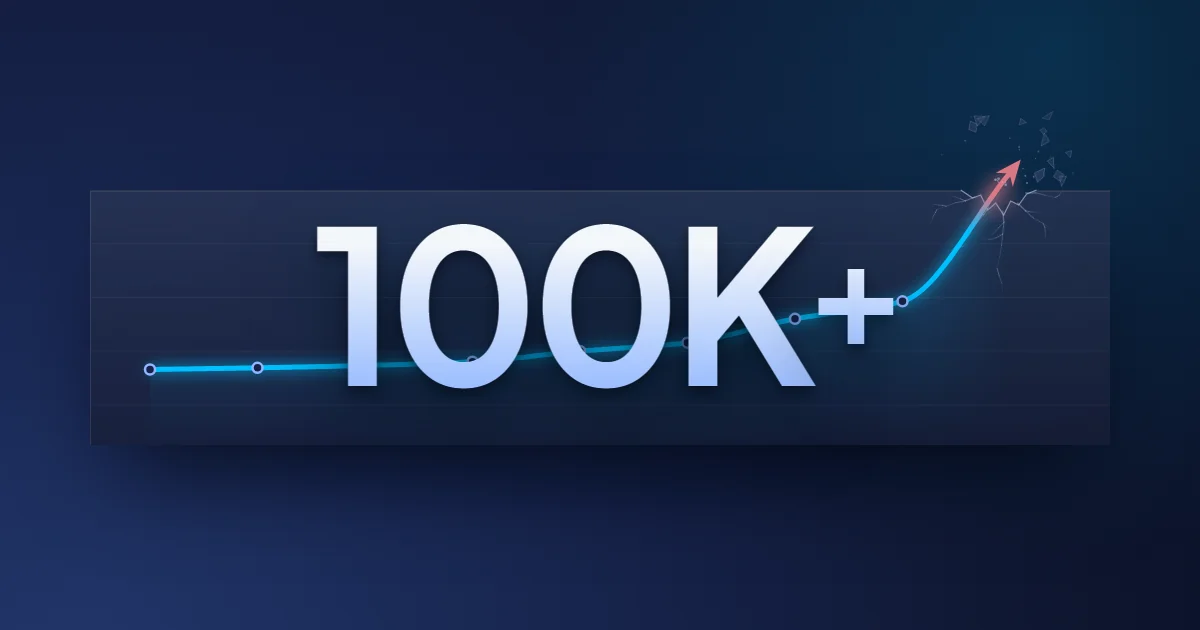
On 13 November 2026, VulnCheck counted 100,222 CVEs (Common Vulnerabilities and Exposures, the public IDs for known security flaws) published this year. The Register reported the count the same day.
No earlier year comes close. In February, the 2026 vulnerability forecast from FIRST, the Forum of Incident Response and Security Teams, put its central estimate at about 59,000.
VulnCheck put the change in one line:
We don't have a security problem anymore. We have a data problem now.
The 2026 CVE count does not mean 100,000 new problems on your network. It means the list you sort through is longer than any team can work, so the sorting method decides what gets fixed. The US Cybersecurity and Infrastructure Security Agency (CISA) reached a similar conclusion when it ended its weekly Vulnerability Bulletin and moved to risk-based prioritisation.
How many CVEs were published in 2026?
More than 100,000 by 13 November 2026, according to VulnCheck's count. That is already more than twice the 48,244 CVE Records published in all of 2025, with seven weeks of the year still to go. It is also far above FIRST's February central forecast of 59,427, which it raised to about 66,000 in June.
The two totals come from different counters and different periods, so the comparison shows scale. It is not an exact growth rate. CVE.org's published metrics back this up. They show 72,812 CVE Records published in the first three quarters of 2026, already 1.5 times the whole of 2025, with Q4 still to be added. Q3 alone added 36,962, so the official count is on course to pass 100,000 once Q4 is in.
That 59,427 was only FIRST's central forecast. Its February 90% interval reached 117,673, so 2026 still landed inside FIRST's range, near the top.
Why are CVEs growing so fast?
AI-assisted vulnerability discovery is driving most of the growth. VulnCheck, a CVE Numbering Authority, told The Register that "vulnerability hunting with AI is driving a majority of what we're seeing."
The CVE Program reached a similar view at its July 2026 forum on AI-enabled vulnerability discovery. Participants reported that AI is raising report volume and the workload of triage, validation and remediation. The costs they named were false positives, duplicates, hallucinated findings and uneven report quality.
Open-source maintainers feel those costs first. According to The Register, curl now sends low- and medium-severity reports straight to its public tracker to cope with the volume.
Critical Java vulnerability: Java4Shell (CVE-2026-114938) →
Are more CVEs being exploited?
In absolute numbers, yes. As a share, not much.
As of 13 November, 1,363 CVEs published in 2026, about 1.4%, were on VulnCheck's KEV list. KEV (Known Exploited Vulnerabilities) catalogues record flaws with evidence of real attacks.
The Register notes the share has stayed relatively consistent. But as VulnCheck pointed out, 1% of 100,000 is a different workload from 1% of 1,000.
Confirmation is also arriving faster. VulnCheck's State of Exploitation 1H 2026 tracks the median time from CVE publication to KEV listing. It fell from 120 days in 2025 to 80 days in the first half of 2026. The php2shell PHP flaws were faster still, fixed on 21 October and on CISA's KEV catalogue five days later.
That measures how fast exploitation is confirmed and listed. It does not show when attacks begin. For 23.43% of the KEV entries VulnCheck added in that half, exploitation evidence existed on or before the day the CVE was published.
Why can't severity set the queue anymore?
Because severity measures how bad a flaw would be if exploited, not whether anyone will exploit it on your systems. CVSS (Common Vulnerability Scoring System) rates every critical the same, whether it sits on an internet-facing server or an isolated test box. At 100,000 CVEs a year, "fix all the criticals" becomes a list your team will not finish.
FIRST's June forecast update named the real constraint:
"it is the human capacity to verify, coordinate, and patch."
The same analysis found that a filter on KEV listing or an exploitation-prediction score above 10% kept the actionable workload flat while publications grew. FIRST chose that threshold for its analysis. Your own may differ.
CISA's Binding Operational Directive 26-04 takes this approach for US federal agencies, ranking on asset exposure, KEV status, exploit automation and technical impact. The 2026 threat landscape from ENISA, the EU Agency for Cybersecurity, shows the gap between published and exploited flaws too. It reports that CISA's KEV catalogue added 245 entries in 2025, a year with more than 48,000 new CVEs. Our ENISA Threat Landscape 2026 summary covers the rest of the report.
What do you need before you can prioritise?
You need an accurate picture of what you run and scans that can see new flaws on it. Prioritisation signals only sort findings that exist in your data. A host nobody knows about, or a flaw your scanner has no check for, never reaches the queue, however good your ranking is.
See everything you run
Wide coverage means your external attack surface, internal networks, web applications and APIs, source code, open-source dependencies, containers and cloud accounts. It takes several methods, namely DAST (dynamic application security testing) against running apps, SAST (static application security testing) against code, and both active and passive scanning. The hosts that hurt most are often the ones outside the inventory, like forgotten subdomains and shadow IT.
The UK's National Cyber Security Centre (NCSC) gives the same advice for mass-exploitation events in its guidance on responding to active exploitation. Check assets beyond your normal scanning coverage, and confirm your scanner has a detection for the new flaw before you trust a clean rescan.
"Organisations are encouraged to provision their own external attack surface management (EASM) solution."
Clean the list before you rank it
More scanners mean more duplicates. The same missing patch shows up from two tools and on five URLs, and one library upgrade can close six CVEs at once. If you rank before you deduplicate, you spend the scarce capacity FIRST describes on noise.
Clean first, so one issue becomes one finding and one upgrade becomes one row of work, while each CVE keeps its own record. Then the ranking has something honest to sort.
What should you rank by besides severity?
Rank by four signals alongside CVSS, namely known exploitation, predicted exploitation, reachability and exposure, and your own rules. Each answers a different question, and none is enough alone. Together they separate the few findings that need action this week from the many that can wait.
Known exploitation
CISA's KEV catalogue is the reference most teams use, and VulnCheck runs a broader one. A KEV-listed flaw on an exposed asset goes to the top. But listing confirms exploitation after the fact, so it is a floor, not an early warning.
Predicted exploitation
EPSS (Exploit Prediction Scoring System) is FIRST's daily estimate of the probability that a CVE sees exploitation activity in the next 30 days. It is the best tool for sorting the large middle of the queue.
Reachability and exposure
An internet-facing flaw outranks the same flaw on an isolated network. In code, a vulnerable dependency function your application never calls is less urgent than one it does. Reachability analysis is a guide. It does not prove that a dependency is safe.
Your own rules
Your rules cover asset criticality, SLA (service level agreement) deadlines per severity, and a short list of things that never wait. Rules make the ranking repeatable, so the same finding gets the same decision next month, whoever is on duty.
Vulnerability lifecycle management · Tamper-evident audit evidence · EU data residency
Keep a record of every decision
At 100,000 CVEs a year, most findings will wait. Waiting is fine. Waiting without a record is not.
For each finding, a useful record shows the signals, the owner and the deadline. It also shows why the finding was deferred or accepted, and when a rescan confirmed the fix.
Take an outdated library on an internal build server. EPSS is low, it is not on KEV, and the vulnerable function is unreachable, so you defer it with a reason. It keeps its SLA clock and stays in every report. Months later it appears on KEV, the decision reopens because a signal changed, and the record shows when you knew and what you did.
That record is also what compliance asks for. The NIS2 implementing regulation is Commission Implementing Regulation (EU) 2024/2690. It expects the entities it covers to scan, where appropriate, at planned intervals and keep evidence of the results.
A record does not make you compliant on its own, but without one you have nothing to show. Our NIS2 compliance guide and the vulnerability management lifecycle cover what an auditor looks for.
Probabilistic signals are fine for spotting threats. But they are the wrong basis for proof. Change a record only on a fixed rule or confirmed evidence, so it reads the same next quarter.
Where does AI fit?
As part of your scanning, prioritisation and verification, not as a replacement for them. AI is trained on decades of human testing methodology. It does not invent new ways to attack; it applies the known ones faster and at far greater volume.
That is why AI finds real bugs at scale. Its value is speed. VulnCheck's State of Exploitation 1H 2026 counted 1,061 vulnerabilities attributed to AI-assisted discovery, of which 14 (1.3%) were confirmed exploited. Volume is not the same as risk.
What is AI good at in security testing?
Speed and context. AI earns its place chaining low and medium findings into a real exploit path, testing business logic and login flows, and adapting tests mid-run. It does best with context like source code and a staging environment. AI adds little on plain checks against the OWASP (Open Worldwide Application Security Project) Top 10, because cheaper scanners have automated them for a decade.
AI is weaker at what a vulnerability programme depends on, namely complete coverage, repeatable results and evidence.
So start by discovering and scanning everything you run with DAST, SAST, active and passive methods. Then pentest exposed, high-risk assets, with humans or AI.
Pentest findings go into the same record, get an owner and a deadline, and are closed by a rescan. A pentest is a point-in-time snapshot, the limit that separates vulnerability assessment from vulnerability management; continuous scanning covers the months between tests. It also gives the pentest a better scope, so the pentest's time goes to the riskiest assets.
Is AI pentesting worth the price?
Only if you can see what it tested and get the same result twice. That matters because many established vendors now push AI pentesting hard, built on frontier models they did not train. Selling a wrapped model at a pentest price is lucrative.
A vendor's "methodology" is mostly context instructions, a prompt on top of what the model already learned. Agents do not always follow those instructions, because models are probabilistic by nature, not deterministic. Some established vulnerability management vendors have admitted removing the custom instructions they added to their wrapped models when the models did not reliably follow them. When instructions make results worse, they tend to get loosened or removed, and most of what the vendor added goes with them.
What remains is a black box. If the methodology is not enforced, you cannot know what the test covered, or whether a second run would find the same things. You pay a premium for that, often a large markup over the cost of the model itself.
The tools that do deliver tend to have their own decision logic underneath, with the model on top. For many teams, a model subscription and a capable engineer would produce a similar result for a fraction of the price.
Much security vendor marketing around AI runs on fear of missing out. Use AI with care, where it shines, such as on source code, because it can hold a lot of context at once. Test it on your own application, not a deliberately vulnerable demo app the model has likely seen in training. Before you buy, ask five questions:
- What runs deterministically underneath the model?
- Can I see exactly what was tested and what was not?
- Can I get the full log of what the agent did?
- Will a second run produce the same findings?
- How do your results on our application compare with our last human pentest?
Vornin also uses AI for on-demand triage and remediation guidance, and to cut false positives in code findings, so rules and probability work hand in hand instead of a statistical model deciding alone.
Checklist: keeping up with 100,000 CVEs a year
Use this to test your current setup:
- Know what you run: keep an inventory that includes forgotten hosts, subdomains and shadow IT.
- Scan on a schedule: cover every surface you can, track coverage gaps, and confirm detection exists for high-profile new CVEs.
- Deduplicate first: merge repeat detections so one issue is one finding.
- Rank on more than severity: combine KEV, EPSS, reachability and exposure with CVSS.
- Set rules that hold: SLA deadlines per severity, escalation on breach, and a list of what never waits.
- Defer with a reason: give every deferral an owner and a reason, and reopen it when a signal changes.
- Verify and keep the record: close findings by rescan and keep the history an auditor can check.
- Use AI deliberately: use it where it excels, and trial it on your own application before you buy.
Read-only access · EU-hosted
Frequently asked questions
Will the number of CVEs keep rising?
Most forecasters expect it to. FIRST raised its 2026 forecast mid-year after publications ran well ahead of plan, and AI-assisted discovery keeps adding volume. VulnCheck told The Register it expects people to look back and say, "remember when it was only 100K?"
What percentage of CVEs are exploited?
A small share. By 13 November 2026, about 1.4% of CVEs published that year were on VulnCheck's KEV list. KEV catalogues are not exhaustive and listing lags exploitation, so treat the figure as a floor, not a complete count.
Should we patch every critical CVE?
No team can patch every critical at 2026 volumes, and severity alone is a poor order. Fix critical findings that are exploited, exposed or reachable first. Defer the rest with a recorded reason and an SLA, and revisit them when a signal changes.
Does a clean scan mean a CVE isn't present?
Not necessarily. A clean result only covers the assets you scanned and the checks your scanner has, as our guide to what a vulnerability scan covers explains. NCSC advises confirming that a detection exists for a new vulnerability, and checking assets outside normal coverage, before trusting a clean rescan.
Can an AI pentest replace vulnerability scanning?
No. A pentest, AI or human, goes deep on a defined scope at one point in time. Continuous scanning finds what exists across your whole estate between tests, and feeds the pentest a better scope.
Conclusion
You cannot fix 100,000 CVEs, and you do not need to. Start this week. Deduplicate your findings, then check which KEV-listed flaws sit on exposed assets. Those go to the top. Record the reason for everything you defer.
Read-only access · Working scan data deleted after each scan · EU-hosted