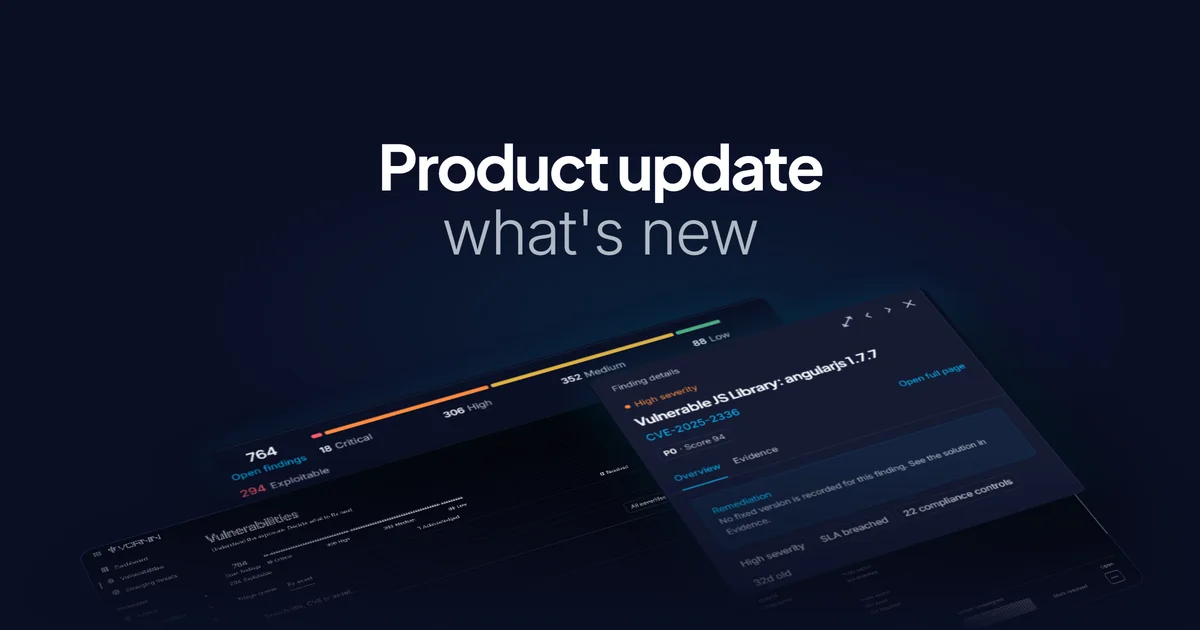
Tickets now follow findings through closure and reopening. The pull request gate now supports Bitbucket Cloud. New checks flag exposed Supabase data, credentials that still work, and container images on an unsupported base. This Vornin product update covers what shipped in September and October 2026, and what each feature needs before it runs.
At a glance
| Feature | What changes | To use it |
|---|---|---|
| Ticket sync | Tickets close and reopen with their findings | Switch on per integration |
| Pull request gate | Now also on Bitbucket Cloud | Pipeline set-up, top plan |
| Supabase exposure checks | Finds Supabase data readable without login | Select the scan type |
| Code scan location | You choose which machine clones your code | Set per connection |
| Live secret check | Leaked credentials that still work rank higher | Switch on, off by default |
| End-of-life image detection | Images on an unsupported base get a finding | Automatic |
| Active probe authorisation | Each active scan records who approved it | Confirm when you enable probes |
Ticket sync
Tickets Vornin files in Jira Cloud, GitHub, GitLab or Azure DevOps now follow their finding.
- A resolved or dismissed finding closes its ticket with a comment, and a finding that comes back reopens it.
- A scan-based close waits until the fix has held for a day, so one scan with a coverage gap doesn't close a batch of tickets.
- Ticket sync also keeps priority (Jira, Azure DevOps) and due date (Jira, GitLab, Azure DevOps) in line with severity and your remediation deadlines, so fewer tickets need manual updates after a rescan.
- A ticket someone closed by hand stays closed, and a sync health page flags it.
Pull request gate
The pull request gate now runs on Bitbucket Cloud, alongside GitHub and Azure DevOps, each with a published pipeline recipe.
- The gate scans the code a pull request would merge and fails the build if the merge would add findings at or above a severity you choose.
- By default, the gate blocks new High and Critical findings.
- Findings already on the target branch don't block, so existing debt doesn't stop unrelated work.
- GitLab merge requests work through the API, without a recipe yet.
Supabase exposure checks
A new scan type finds Supabase data that anyone can read without logging in.
- Apps made with AI app builders such as Lovable or Bolt often run on Supabase without IT review, a form of shadow AI.
- Missing access rules can expose application data to anyone who finds the app.
- The check reports tables that return rows without login, public storage buckets, and admin keys shipped in the app's code.
- Scans never write to the database, and the evidence keeps row counts and column names, not values.
Code scan location
For each repository connection, you choose which machine clones and scans the code.
- The options are Vornin's servers, your own scan agent with Vornin as fallback, or your own agent only.
- Code from internal Git servers can stay inside your network.
Live secret check
When secret scanning finds a credential, Vornin can check whether it still works.
- A rotated key is clean-up work; a key that still opens your cloud account is an incident.
- A live credential is marked real and raised in severity.
- Switched on, the check sends some credentials outside Vornin. AWS, GitHub, Slack, Cloudflare and Datadog credentials are validated against the provider from Vornin's scanner IP, which may appear in your provider audit logs.
- JSON Web Tokens (JWTs), private keys, Azure shared access signature (SAS) tokens, Supabase keys and PyPI tokens are checked offline.
- Other credential types are still reported but not confirmed live.
End-of-life image detection
A container image on an end-of-life base now gets a High finding.
- Before, these images came back with zero findings, because the distribution no longer publishes security data.
- Earlier findings on the image stay open instead of being marked fixed by a scan that could not re-detect them.
Active probe authorisation
Active probes now run only after a named user confirms they are authorised to test the target.
- Probes send intrusive payloads that can create records or lock accounts.
- Schedules ask on every save that keeps probes on and show who confirmed and when, so you have a record of each approved active scan to show a hosting provider, customer or auditor.
Also shipped
Three smaller changes went live:
- Unresolved dependency reporting: when dependencies can't be resolved, the scan names the files and the reason instead of returning a clean result.
- Guided scan setup: scan setup now takes three steps (scope, coverage, review), and you can add a new host without leaving the scope step.
- php2shell detection: web scans flag hosts that report a PHP version affected by php2shell, and container scans check official PHP images.
Already using Vornin?
Three settings are worth ten minutes this week:
- Turn on ticket sync on each issue tracking integration.
- Decide on the live secret check under Settings → Scanning, against your policy on sending credentials to their providers.
- Check where code scans run on each repository connection, especially for internal Git servers.
Thanks for your feedback
Some of these improvements started with customers using the Wish box in the app or emailing us directly. Thanks for telling us what needed to work better. Keep the feedback and suggestions coming through either channel.
Read-only access by default · Working scan data deleted after each scan · EU-hosted